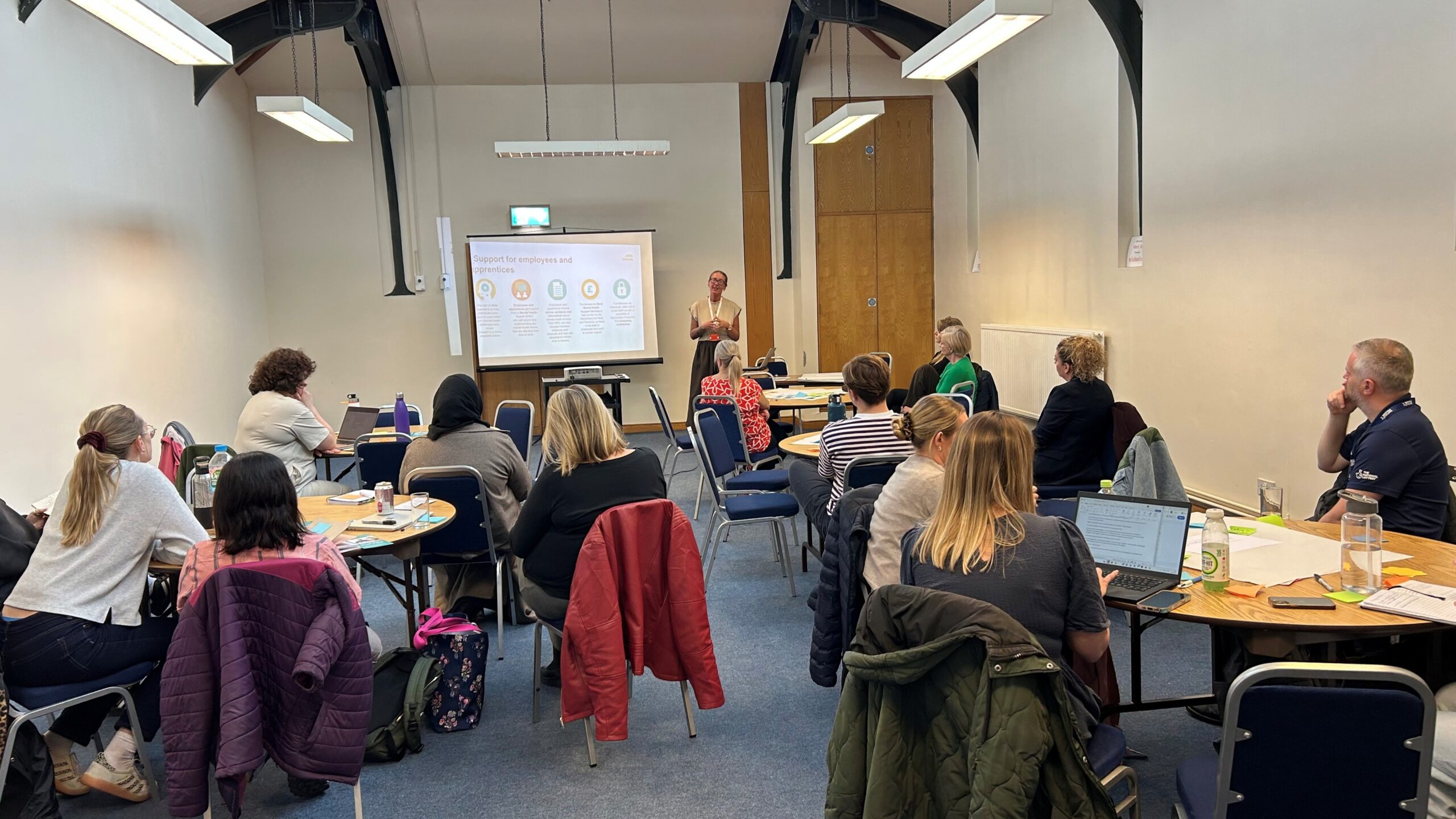
In late May 2026, GM Moving delivered the third event in a series of shared learning sessions, exploring the potential of using physical activity and movement in social care prevention.
Working in partnership with system change consultancy Noisy Cricket, GM Moving invited people and organisations pushing boundaries in this space through investing in workforce wellbeing.
Together, we explored the various ways in which social care workers – whether paid or unpaid – need care and consideration, and the ripple effects it has on the care they’re able to provide.
Hosted by GM Moving’s Kate Harding, and led by Noisy Cricket’s Lauren Coulman, the event welcomed opening comments from Greater Manchester’s Integrated Care Board’s Assistant Programme Director for Workforce, Jo Finnerty.
This was followed by in-depth explorations of simply getting the basics right for unpaid carers by Georgette Kay from Bolton Carers Network.
We also learned about the importance of mental health and emotional wellbeing in the face of the challenges that social care work can bring from Angela Han and Miriam Mintz from Able Futures.
The session closed out with an honest exploration of what’s needed to embed physical wellbeing into social care workplaces with Laura Parker and Marie Hare from Tameside Council.
Every corner of social care was covered. The event representing social care endeavours across Greater Manchester, spanning residential care homes and day centres to leisure facilities and social clubs, working with elderly residents, people with learning difficulties and disabilities as well as individuals struggling with mental health challenges.
In doing so, five key learnings emerged around the needs, approaches and activities required to realise the potential of physical activity and movement in the social care sector.
Five key learnings to realise the potential of physical activity and movement in the social care sector:
-
1. The quality of your workforce’s life is equal to the quality of care you can provide
In opening the session, Jo Finnerty made clear that caring for the people doing the caring is a precondition for social care.
While physical activity and movement has a key role to play, financial wellbeing plus mental and emotional health are vital first steps in investing in workforce wellbeing, as well as recognising the importance of social connection too.
As a low-paid, high-pressure occupation, the lack of financial stability combined with the time-consuming and isolating nature of the work can take a significant toll on people’s ability to sustain healthy, meaningful relationships, both inside and out of work.
With the stress having a compound effect on care workers’ mental, emotional and physical wellbeing over time, the moral case for caring for the workforce was made clear.
There’s a strong business case too, not just in reduced sickness, burnout and staff turnover costs, but in the quality of care provided too.
Employers who put their workforce’s best interests first and model what good care looks like are more likely to see it mirrored in the services provided.
At its most basic, team members need to feel a sense of financial safety, professional and personal belonging plus wellbeing that enables them to show up and give their best to residents and patients, day in and day out.
Therefore, it’s the culture of the organisation, and the structures put in place to support staff, that are the strongest determinants of excellent care.
A clear purpose, a values-led culture, and holistic personal support for staff are what ensure people working across the sector can feel aligned, motivated, and best able to provide exemplary person-centred care. So, considering the context of your workforce’s life is key.
Starting with financial safety nets, whether providing hardship funds or encouraging access to credit unions, and having transparent pay structures or removing zero-hours contracts, the participants of the session were clear on what the foundations for workforce wellbeing could look like.
More broadly, considering how wellbeing can play a role, from recruitment through to day-to-day policy and processes, offers a huge opportunity for employers looking to improve the quality of care from the inside out.
-
2. Valuing the Skills and Strengths of Social Care Workers
For the majority of the social care workforce, there are no employers to consider what’s important to them or care for the wellbeing of those providing care.
With over 50% of the sector’s workforce made up of unpaid carers or volunteers, managing financial security, mental and emotional wellbeing and social connections often comes second to the family, friend or loved one being cared for, often at great cost to the individual.
Considering that the social care system would collapse without the unpaid and deeply undervalued labour of carers – for a role very few of us would choose were it advertised as a position – the saved costs in prevented readmissions and supported reablement alone make a strong case for supporting unpaid carers to tend to their own wellbeing.
Yet, with people often failing to recognise their own role as carers, let alone the system that relies on them, we continue to compromise carers’ health and wellbeing, with long-term consequences for both.
Georgette Kay, whose personal and professional experience in advocating for and supporting unpaid carers helped highlight that while every carer’s journey is unique, their touchpoints with and journey through the systems intended to support such situations are similar.
Therefore, taking small basic steps to uphold carers’ rights to a good quality life can go a long way. Everything from helping people understand the benefits they can access, to providing the mental and emotional support needed to sustain people through everything from crisis points to the ongoing emotional and physical labour care requires.
Working with Bolton CVS over the past few years to explore how the system can better support the part of the social care workforce most in need of investment, an Empathy Charter has emerged, alongside a plan of action focused on recognising, recording and referring carers to the support options and organisations available to them. It’s a vital first step, yet people’s ability to navigate both professional roles and personal care responsibilities was flagged too.
Unless a senior leader or manager has experienced caring first hand, the understanding and flexibility needed to navigate complex care situations is rarely offered by workplaces and employers.
Carers don’t want the world – just to be recognised, valued and provided enough support to be able to manage. Yet, in denying it, workplaces are missing out on the unique skills and strengths that carers bring on account of their dual roles, including time management, problem-solving and the ability to navigate complex systems.
Workplaces not only fail to take advantage of these transferable skills, but often work against them. Not only does this mean more personal stress and strain, but also impacts people’s ability to perform professionally too.
A little understanding and support goes a long way in retaining and motivating employees who have care responsibilities. Yet, despite the nature of work the public sector delivers, session participants flagged that it lags way behind the VCFSE sector when it comes to employers’ strategies for carers.
-
3. Investing in a Culture of Wellbeing
Emphasised by speakers and participants across the session, workplace culture was seen as key.
The ability to financially value and emotionally support the social care workforce is rooted in the beliefs and attitudes around social care as practice, and whether it’s about demand and cost management or the dignity and quality of life of the people connected to it.
In a role where exhaustion, compassion fatigue, vicarious trauma and burnout are common, it makes all the difference in how paid and unpaid carers are treated.
With time and task approaches and limited resources inhibiting how effectively the workforce can care too, the system overly relies on the care workforce’s care and compassion to go above and beyond, which over time, understandably, comes at both personal and professional cost.
Reliance on medication, physical illness and chronic conditions can result. Yet, rather than organisations taking responsibility for the conditions that push the social workforce into requiring the very services they’re hoping to prevent the need for, people first question their own ability to cope and resilience.
With poor mental health being the greatest cost to employers across all workplaces, the unique challenges and high cost that social care poses to the workforce and employers alike require cultural investment.
For Angela Han and Miriam Mintz of Able Futures, this looks like psychologically safe workplaces, where people have permission to share when they’re struggling and trust that action will be taken to support or empower them to do things differently.
One thing employers do need to recognise is that often, people don’t always have the emotional literacy to recognise what’s going on in their lives, or feel able to articulate what they need to enable their roles.
Even more difficult is challenging the unhealthy working practices common to social care, and advocating for yourself in a sector where people are undervalued.
The gendered nature of care and the makeup of the social care workforce only compounds the difficulty in navigating unspoken expectations.
It’s why organisations like Able Futures are brought in, to help people across the social care system to understand, name and act on what they need.
While the work is underpinned by the NHS’s five ways to wellbeing – supporting people to examine what they’re eating, drinking, sleeping, moving and connecting with others – it equally requires the employer not just to listen and permit people to care for themselves, but also to provide the supporting infrastructure needed to actively enable it in the workplace.
The session’s participants took this a step further, suggesting that more than just a shift in employment practises, a whole-system approach was required.
Accountability for living the values needed to work in person-centred and context-informed ways, co-production with employees and communities, a dedicated wellbeing function, and closer working with the VCSE sector where much of this is already normalised.
It was made clear that culture is something that needed to be lived and breathed, with residents and the workforce at its centre.
-
4. Embracing Personal Preferences and Passions
It’s what makes the work happening at Tameside Council so exciting.
Recognising that physical activity and movement can play a significant role in upholding mental and emotional wellbeing for social care workers, who, despite the pressure, demands and complexities of the work, have limited control over how it’s delivered.
Recognising its power in helping prevent the need for social care amongst residents and patients too, the council have recognised that its practice has to start internally.
Taking a test and learn approach to embedding physical activity and movement within the working day, everything from training, campaigning and individual support has been explored, with failures and successes along the way.
So far, the biggest learning has been around meeting individuals where they are. While some people already love to get active and move their body outside of work, others have little to no interest or motivation, so understanding why they want to move their body, and how people’s personal preferences and passions play a part has been key.
Yet, to take Tameside Council’s staff on a personal journey around physical activity and movement first required a wholesale shift in how it’s culturally perceived and approached by the wider organisation.
With councils under significant scrutiny around how time and money are spent, it took time and experimentation to see that while knowledge boosters looked good on paper, it was walking and talking sessions where messages around the power of physical activity and movement for social care staff and residents alive took hold.
Train the trainer and physical activity champions are now starting to take hold across the council, but the team – currently stuck in the space between Work and Employment and Public Health – are looking to find alignment across multiple policies and strategies to help physical activity and movement become the norm in how social care is delivered.
With senior leadership buy-in starting to emerge, thanks to Marie Hare and Laura Parker’s persistent advocacy.
The reality they shared, of creating ripple effects that will help advance how physical activity and movement can support social care prevention, will take time, and everything from adapting language, co-creating solutions with the workforce and communities and (in some instances) mandatory engagement are being utilised.
The biggest challenge, however, is bringing people working in siloes across the public and social sectors together, to unlearn old ways of working and embrace new behaviours.
-
5. Making a Business Case for Adaptive Leadership
Celebrating small wins along the way is essential, but for strides to be made in enabling workforce wellbeing, participants felt strongly that the business case also needs to be made for senior leaders to shift the cultures, build the infrastructure, and support the personal journey needed to realise its benefits.
The return on investment, from reduced sickness through to improvements in the quality of care needs to be clarified, before how time and money are spent can be meaningfully shifted.
What also needs to be made clear in building a case is the time and space needed for the shifts to take root. This is deliberate, mindful work, and requires space for professional curiosity and personal challenge, which means it requires leadership modelling, reinforcing and rewarding what the new ways of working look like.
Financial stability, emotional literacy and personal alignment all need to be demonstrated top down, while simultaneously listening to what’s important from the bottom up.
Therefore, it’s reflective and adaptive leadership that’s required, listening and acting on what good looks like for every actor in the system, above and beyond what the system believes is needed to deliver social care.
Everything from soft metrics to balance hard numbers, and lived experience alongside the learned experience of the workforce is key.
To transform the social care system and truly enable prevention, the work begins within, and starts with caring for the workforce – the living infrastructure on which the care system depends.