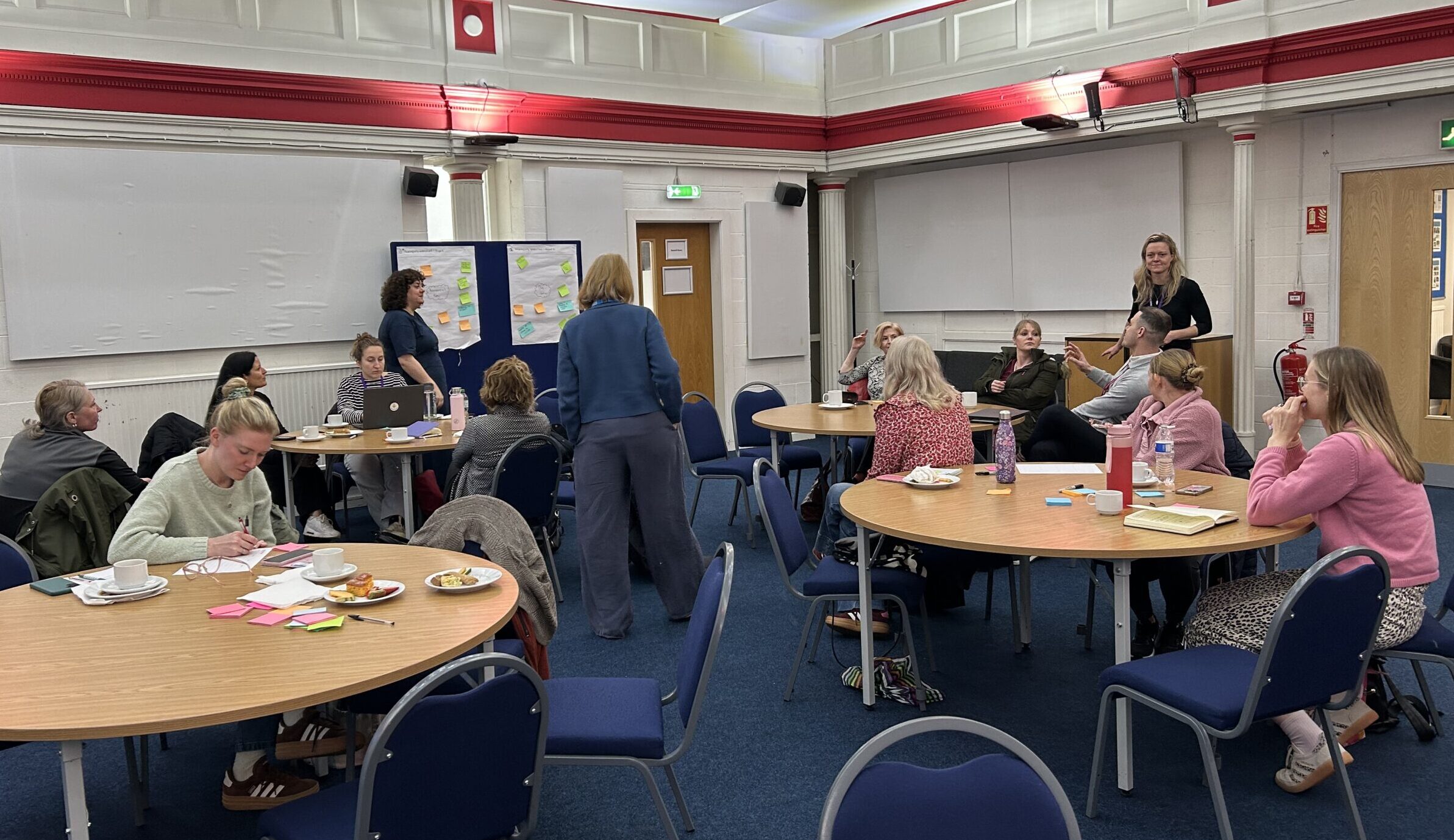
In early February 2026, GM Moving delivered the second event in a series of shared learning sessions, exploring the potential of using physical activity and movement in social care prevention.
Working in partnership with system change consultancy Noisy Cricket, GM Moving invited people and organisations pushing boundaries in this space through the delivery of link roles. Together, we explored how important it is to consider the context of people’s lives when navigating complex social care situations, public spaces and opportunities to bring people together in unique and inspiring ways.
Hosted by GM Moving’s Beth Sutcliffe and Kate Harding, and led by Noisy Cricket’s Lauren Coulman, the event invited opening comments from Salford City Council’s Public Health Strategy manager, Zoe Hammett.
Followed by in-depth explorations of the importance of enabling behaviour change by Charlotte Leonhardson from NHS Greater Manchester, we also learned about the potential to adapt spaces and skills for inclusion by Dan Higgins at Active Tameside. The session closed out with a powerful demonstration from Dementia Disco’s Kate Darby of what’s possible when the needs of family, friends and the communities are considered as much as those in need of care.
Representing social care endeavours across Greater Manchester, spanning residential care homes and day centres to leisure facilities and social clubs, and work impacting elderly residents, people with learning difficulties and disabilities and individuals struggling with mental health challenges, every corner of social care was covered.
“We need to recognise the importance of non-traditional models of care: models that start with people rather than services; that value lived experience; and that pay attention to the small, everyday things that help someone live a fuller, more connected life.” – Zoe Hammett, Salford City Council
Five key learnings
During this event five key learnings emerged, on the needs, approaches and activities essential to realising the potential of physical activity and movement in the social care sector.
1. Linking Up at a Systems Level
Building on the needs which emerged from GM Moving’s first shared learning event, it was clear from the outset that the success of link roles is wholly dependent on the social care workforce’s ability to deliver person-centred care. What uniquely enables link roles to do this is the inherent permission to consider and respond to the context of people’s lives, their unique needs and individual preferences.
Yet, in her opening speech, Salford’s Zoe Hammet made clear that such approaches are still the exception, and that there is a long road to travel before the (1) space, (2) flexibility and (3) relationships necessary to truly put people first enable social care to deliver the dignity, independence and quality of life it aspires to.
Operating in the space in between roles, organisations and sectors, link roles like social prescribers and community link workers are showing what’s possible when time and task-led approaches are abandoned, and allow people the autonomy to determine what they want and do things for themselves to work towards a meaningful and fulfilling life.
Yet, with the wider social care system struggling to coordinate and communicate effectively, its ability to invest and enable link roles full rein is limited, evidenced in the struggles around continued commissioning, mass redundancies and the search for alternative income models by the speakers and organisations participating in the event.
Until the wider system is able to replicate the person-centred, agile and boundary-spanning approaches being lived and breathed in link roles, the ability to move towards prevention and early-stage interventions is limited, and opportunities to use physical activity and movement as a lever for change will remain an optional extra.
2. Enabling Navigation and Connection across Care Settings
While the system as a whole struggles to work collaboratively, the ability for link roles to meaningfully connect people to other people, services and opportunities is showing up in certain parts of the system. Day centres and community spaces in particular, are much better at building and leveraging in-depth local knowledge through place-based working.
Working closely with more open care settings is how link workers are able to navigate systems and co-create solutions with people in need of care, rather than simply signpost or refer people into pathways or services that require stricter adherence to access requirements and pre-determined processes.
The more rooted or isolated the care setting, the more standardised provision tends to be too, though commissioning requirements and care provider culture can create space for more open and considered ways of working with people in need of. A focus on approach over deliverables here is key.
However, truly great practice considers the wider friends and family of the person in need of care, and in exceptional cases, the wider community too. It’s why Demantia Disco’s use of social clubs for the whole family to move their body and experience joy is so powerful, because it considers the impact of degenerative illnesses on more than just the patient.
Yet, for family and friends to be included in social care in a meaningful way, trusted relationships need to be built over time, so that everyone feels supported, the solutions shaped are holistic, and social care workers (regardless of care setting) can offer continuity while tailoring solutions as circumstances change over time.
It’s why being connected to the wider community – understanding what’s suitable, accessible and culturally relevant for different situations – is so important. Yet, with a disjointed system, funded across the NHS and local authorities and delivered through private businesses and VCFSE organisations, link roles often have to build connections, forge networks and establish platforms of their own volition.
3. Empowering Behaviour Change in Communities and Organisations
In addition to being able to build trusted relationships that get to the root of what’s going on with people, plus work as connectors and navigators in the disjointed places they work, link roles are also required to be versed in behaviour change and how best to enable people to take the necessary steps to transform their own lives.
Currently, social care is designed to meet people’s basic needs and avoid potential safeguarding issues, but for early intervention to work, it requires empowering the people in need of care to go beyond simply maintaining their own conditions and circumstances. To do that requires first exploring what matters to people, then gauging how ready they are to make a change.
Only then can the work kick in to help people take the next step, with Charlotte Leonhardsen’s work in social prescribing over the past decade showing that motivation is as important as autonomy, helping overcome the resistance and tensions that often underpin people’s ability to help themselves. It’s why listening is so integral to the work.
Yet, listening is rare, with health and social care alike often determining what’s best for people, contributing to the persistent health and social care issues that result in the sustained demand and strained budgets experienced across both systems. Yet, the more you build confidence and independence, the more successful and sustained the outcome.
In prevention is the real goal, it means moving towards less dependence on support services and care settings, and going beyond simply providing activities to supporting learning and the development of skills. Yet, to work in such a strengths-based way requires behaviour change at a systems level, as much as in the people needing care.
4. Adapting Roles and Spaces for Better Connection
It’s why empowering staff in link roles is just as important as empowering people in need of care, but to do that, organisations need to let go of existing ways of doing things, whether it comes to how roles are delivered or spaces are used. An example of this is Active Tameside moving from a leisure provider to a health and wellbeing enabler for all.
Adapting schedules to make space for people with learning difficulties, considering sensory needs and creating more robust physical spaces to be able to hold more challenging behaviours was only the start of it. Staff were also retained in social care practices, to better support people disabilities and learning difficulties to make leisure inclusive and accessible to all.
New personal behaviours precipitated a shift in culture too, holding form against wider societal attitudes towards sharing spaces with people who have different needs. It was also key to be rooted in a whole family approach, building on existing community assets and using a values-led approach in working alongside the local authority and NHS.
Enabling access to people who rarely get to enjoy physical activity and movement, the session also opened up conversation around how other public and community spaces might be adapted, from local parks and community centres to libraries and workplaces. When accessibility, inclusion and relevance are looked at anew, it’s the sense of safety, welcome and support that make social care prevention all the more possible.
5. Relationships are Everything
Whether taking time or using space differently, or being flexible and finding new ways to approach social care, at its core, the foundation of link roles, spaces and activities is relationship. This includes relationships between the social care workforce and those in need of care, as demonstrated by Charlotte Leonhardsen’s work through the NHS.
Important too are the relationships with friends, family and the wider communities we live in. This was seen in Dementia Disco’s strength in bringing people together around the shared joy of dance. The relationships we have to the places we live in matter too, regardless of setting, and across silos. This is being modelled by Active Tameside every day.
Yet, most progress is being made by leaders for whom care is personal, informed by their own or loved ones’ lived experience of care. Zoe Hammett opened the session, sharing how her uncle and sisters lived experience of the care system inspired her own work to bridge the gaps between public health and social care, and the desire to make sure no-one else struggled in the way she and her loved ones had.
This is why movement which enables connection and joy are just as important as those activities which focus on physical health and mental wellbeing. It is easier to commit to moving your body regularly when you feel part of something, whether you’re at your local swimming pool or the social club down the road.
It’s when we move beyond institutional efficiency to the deep human yearning for connection that the real magic happens, so rather than addressing gaps in services, it’s in only when we address the isolation we’ve designed into the social care system that true prevention can be achieved.
This is why the movement for movement is so powerful.
Join our next event
Explore how movement and physical activity can support workforce engagement in person-centred social care at our next shared learning event.