
Place Partnerships
Our mission is to enable active lives for all by reducing inactivity and health inequalities. Through a place-based, collaborative approach that brings together people, communities, and organisations to create sustainable solutions to inactivity. By supporting people and building on the unique strengths of each place, we aim to break down barriers and create opportunities for everyone to live healthy, active lives.
Why it matters
We know that place matters. Where we are born, live, work and play profoundly shapes our opportunities to live healthy, active lives. Nearly 1 in 3 (28%) of Greater Manchester residents are active for less than 30 minutes a week, missing out of a range of benefits to their physical and mental health. There are stark and stubborn inequalities in activity data too with an 11-percentage point difference in inactivity rates between our most active borough (24% inactive) and least active borough (35% inactive), in the latest Sport England data. Our place-based, collaborative approach addresses the deep-rooted inequalities and systemic barriers that determine who can move, be active, and thrive so everyone has the opportunity to live a healthy, active life.
Who is involved?
We know that inactivity is a complex challenge that requires collaboration, no single person or organisation can do it alone. That’s why each of Greater Manchester’s 10 boroughs has a ‘place partnership’ a network of local residents, community organisations and key partners who share a common passion: creating healthier, happier and fairer communities. They recognise that physical activity, sport and movement plays a vital role in achieving this, even if they aren’t directly involved in delivering sports or physical activity. By bringing together their diverse range of knowledge, skills and resources, they break down barriers to activity and help more people lead active, healthy lives.
Learn more about the place partnership work in each area: Bolton, Bury, Manchester, Oldham, Rochdale, Salford, Stockport, Tameside & Glossop, Trafford, Wigan.
What is Place-Based Working in Physical Activity, Movement and Sport?
Place-based working is an approach that starts with the people and the place – not with a one-size-fits-all programme. It means designing ways to help people be more active that truly fit the local community: its needs, its strengths, and its surroundings.
Instead of simply delivering a service, place-based working looks at the whole system – from local parks and pavements to schools, community groups and council services. It brings together local people and organisations to work as partners and make decisions together.
Brinnington Confidence Walks
In Brinnington, Life Leisure and Age UK Stockport developed the Confidence Walks based on conversations with local residents. When delivering outdoor walks, people shared the challenges they faced in getting active – things like poor weather, long distances, a lack of benches, uneven paths, and inaccessible routes. Most of all, it became clear that confidence was a key barrier.
To overcome this, the Confidence Walks were designed with safety, accessibility, and reassurance in mind. Held indoors in a sports hall in the centre of their community, the walks are set up with chairs in the centre so people can rest at any time. The smooth, flat surface creates a more comfortable environment for those with low mobility, low confidence, or concerns about walking outdoors. It’s a simple but powerful example of listening to the community and shaping a solution around their real needs.
Why take a place-based approach to inactivity?
Across Greater Manchester, our communities told us that that they didn’t want to be “done to” but, wanted to share their local knowledge and work together to create solutions that built on the strengths of their communities.
We often saw that short-term, top-down, interventions didn’t work or only engaged those that were already likely to be active. By focusing on the deficits of a place, we overlooked community strengths, damaging relationships and failing to address the root causes and barriers of inactivity. When these programs ended, the same barriers remained, and communities were left frustrated when little had changed.
We also noticed that when these interventions did work, we would try to copy successful projects from one place to another. We assumed that if something worked in one community, it would work everywhere. But this failed to acknowledge that every community is different and reflect on the what the unique conditions, or strengths, that made it successful in the first place. When this approach didn’t work, we would dismiss the idea instead of reflecting on why it had not worked and what we could do differently next time.
It became clear that we needed to try something different.
What makes us different
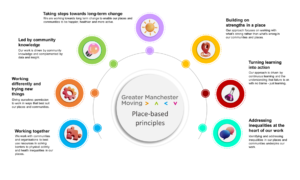
Our approach is underpinned by a set of guiding principles that were co-designed by our place partnership teams across Greater Manchester. These principles guide our approach and support meaningful, sustainable change and community-led solutions. We know that how we make things happen, is as important as what we do.
We know that strong relationships are key to tackling inactivity and inequalities, not just within each borough, but across Greater Manchester and the wider region. By prioritising collaboration and collective action, we can align efforts across sectors to break down barriers, close health gaps, and create opportunities for everyone to live an active, healthy life.
Get involved
Whether you’re a community member, organisation, or leader, there’s a role for you in enabling active lives for all. Learn more about our partnerships, projects, and how you can collaborate with us to tackle inequalities and create healthier communities.
- Learn more about the place partnership work in your area (Bolton, Bury, Manchester, Oldham, Rochdale, Salford, Stockport, Tameside & Glossop, Trafford, Wigan).
- Learn more about our journey so far and how we support our localities through four catalysts functions; Evaluation, People and Leadership, engagement and marketing (see below)
- To sign up to our monthly newsletter please email: stephanie@gmmoving.co.uk
Further details please contact
-
- Nicole McKeating-Jones
Strategic Lead – Place Partnerships - nicole@gmmoving.co.uk
- 07395795933
- Nicole McKeating-Jones