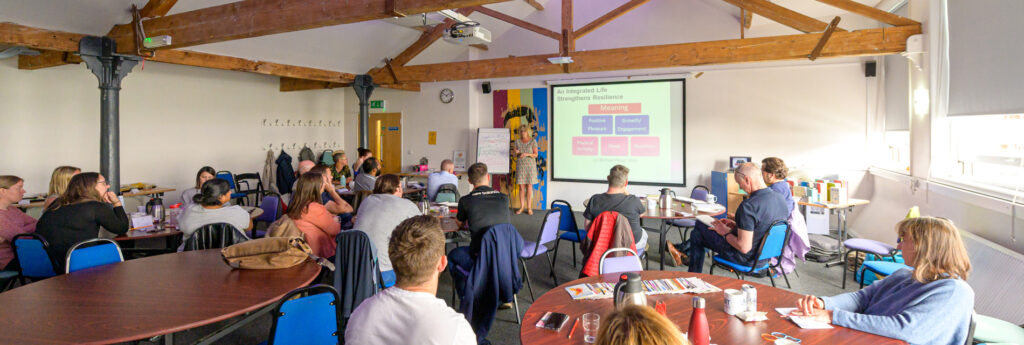

Julia Skelly, GM Moving’s Active Adults Lead, sat down with Salford University’s Colleague Wellbeing Manager, Lucy Heffron, Physical Activity and Wellbeing Operations Manager, Daley O’Neal, and Wellbeing Exercise Referral Instructor, Heather Millington, to learn how their prioritisation of being active in the workplace was paying off for colleague wellbeing.
After the success of the student physical activity referral pathways, Daley and Heather knew that the impact could be the same with their colleagues.
Using the students’ outcome data they were able to report the benefits to senior leaders and get the green light to start a colleague support pathway.
Working closely with the Mental Health First Aid (MHFA) Network (an incredible 60-strong group of staff trained in MHFA to support their colleagues) they were able to set up a referral system for those reporting concerns with their mental wellbeing and stress in work to take part in an eight-week, free of charge gym program.
This has since developed into a self-referral system that allows staff to book onto an 8-week physical activity programme supported by the Physical Activity Team.
The scheme launched in June 2025 and has already helped 20 members of staff who get to attend one coached session a week during working hours and unlimited use of the gym for their personalised plan.
Staff reported increases in confidence, decreases in stress and anxiety, and a long-lasting joy of movement with wellbeing scores are up 11 points on the Warwick Edinburgh Mental Wellbeing Scale.
Colleagues said:
“The colleague wellbeing service has done nothing short of changing my life. It’s helped me build my confidence both inside and outside of the gym, and it gave me something to look forward to every week as a way to release any stresses I had. It also helped me to empty my head and focus on something extremely positive.”
“I wanted to refer myself in to help with burnout which I had experienced last year.”
“I feel a more positive mindset – I would say it is an outlet and coping mechanism when things get stressful at work.”
“It’s given me much more energy and I have recommended the scheme onto colleagues, who have also started their own journey.”
“It has made me more conscious of self-care and how exercise is so important not only to the body but also to our mental health.”
“I look forward to going to the gym and can feel the benefits for my mental health.”
“The continuing encouragement help and advice during the sessions have been so good for my wellbeing and health, I honestly do not know where I would be now without the help from the team”
Layers of Support
Meanwhile, the university’s physical activity team have also completed 335 health checks which test blood pressure, blood cholesterol and blood glucose, grip strength, waist circumference, and BMI.
They’ve also hosted 13 health awareness events, in partnership with the School of Health and Society and the Colleague Wellbeing Network, linked to women’s health, menopause awareness, and men’s health.
The team also runs “Learn to Lift” sessions in office spaces that teach the basics of strength training in an accessible way to remove barriers to participation. 63 colleagues have accessed this training so far.
Sessions can be booked through the university’s Colleague Wellbeing Hub with 30 people joining the gym as a result of attending, showing how effective it is to meet people where they are and remove barriers.
The list of options for staff to build movement into their day doesn’t end there. Delivered by the various wellbeing teams, the staff have a variety of options including:
- Monthly walk round campus
- Running Club & Couch to 5k groups
- Guided strength break video to break up sedentary behaviours
- Physiotherapy, sports injury, and podiatry clinics
These opportunities are further supported by numerous upskilling sessions on health and wellbeing such as:
- Wellbeing series for managers (including sessions on stress, women’s health, and having effective wellbeing conversations)
- Regular wellbeing webinars for staff
GM Moving are hosting a Moving Conversations (Train the Trainer) session that allows attendees to facilitate sessions on how to have conversations about movement in a joyful, person-centred way.
We’re thrilled that the University of Salford have put forward two MHFA Network members attend this, so that the training can become an embedded part of the MHFA training programme. This will help individuals be more comfortable discussing movement and physical activity with their colleagues as a form of health and wellbeing support.