Latest physical activity data released for Greater Manchester's boroughs
More adults than ever before are moving according to the latest Active Lives release from Sport England. Greater Manchester is also closing the inequalities gaps with the inactivity gender, socio-economic, disability and age gaps all seeing reductions

Share
Following the latest (November 18-19) Sport England Active Lives data, released in April, we have now received and analysed the data at both a Greater Manchester (GM) and borough level to understand the key differences that exist between different demographics.
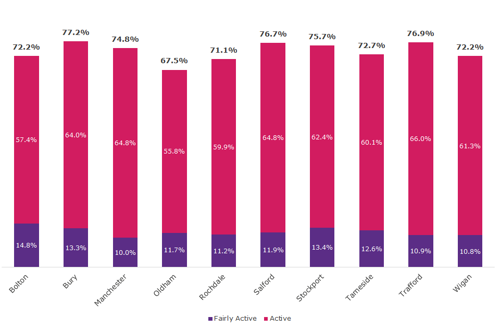
Since the survey launched in November 15-16, the active population (those who do 150+ minutes of physical activity a week), has increased by 2.6%, this is more than double the national increase of 1.2%. As a whole 73.8% of adults in GM are moving (active and fairly active), however, this level varies significantly across the 10 boroughs of GM; there is a 9.7% activity gap between Bury and Oldham, the boroughs with the highest and lowest physical activity levels.
It is particularly promising to see the progress being made in tackling inequalities across the city region. There are reductions in the gender (-0.6%), disability (-1.3%), socio-economic (-3.1%) and age (-8.2%) gaps with the two latter activity gaps now being smaller than the national figures.
These are promising steps forwards in reducing the inequalities in physical activity levels across GM, however, there is still more to be done; the gender and disability gaps both remain larger than the national figures and are closing at a slower rate. This is particularly pronounced with the disability gap, which is decreasing over two times faster nationally than it is in GM.
At a borough level, the majority of boroughs are also showing reduced activity gaps;
- Seven of ten have reduced the gender gap.
- Six of ten have reduced the disability gap.
- Five of eight have reduced the socio-economic gap.*
- Six of eight have reduced the age gap.*
*Some areas did not have enough responses for certain demographics at either baseline or in the latest release, this means that the inactivity gap change over this time period can't be calculated.
Click here to see a full breakdown of the Greater Manchester and borough level data.
Latest News

Empower Her: Lessons from a place-based approach to widening access to football
The 'Empower Her' fund supports inclusive football sessions, leadership pathways, and stronger local partnerships.

National recognition for Prehab4Cancer as it launches education initiative for leisure centre staff
Experience, education and data garnered by the pioneering Prehab4Cancer (P4C) programme in Greater Manchester has helped to shape national guidelines on cancer care adopted by the NHS and Macmillan Cancer Support.

Race Equality Week 2026: Why change needs all of us
By understanding cultural norms, feelings of belonging, and how safe people feel in a space, we can make physical activity more inclusive for everyone.