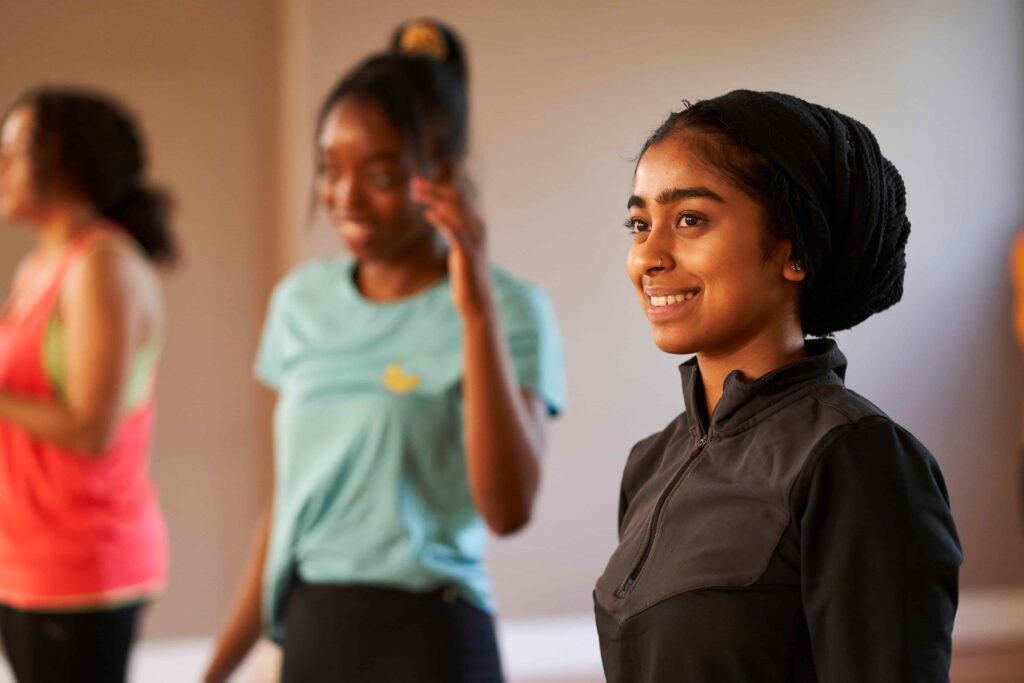
Active education plays an integral role to support the GM moving priority to ensure that all children and young people can lead active lives.
Active education plays an integral role to support the GM moving priority to ensure that all children and young people have a positive and meaningful relationship with movement, physical activity and sport.
We know that childhood and adolescence is a key time in a person’s life to create healthy, lifelong habits.
With children and young people spending a large amount of their time within education, it presents a key opportunity to work with them, their famillies and the trusted adults around them to help them move more, ensure they have opportunities with sport physical acitvity and movement that are positive and help them build a lifelong relationship with movement. We can do this by providing a variety of activities, both formal and informal, and adapting what’s offered based upon interest og children and young people and what they tell us.
We also know that physically active children are happier, more resilient and more trusting of their peers. Ensuring that children and young people have access to sufficient daily activity benefits both the child and the school by improving behaviour and enhancing academic achievement.
In Greater Manchester only 50.1% of children and young people in Greater Manchester are classed as active (Active Lives Children and Young People, 2024-25.). This includes activity during the school day, both curriculum time and break times, and outside of school highlighting a need for us to tackle this together.
To help us achieve these priorities, partners across Greater Manchester are working together to support our schools to become more active. The following section outlines some of these programmes and approaches.
This survey gathers data on how children and young people engage with sport and physical activity and helps us to understand their attitudes and behaviours towards it. This can help us to shape better opportunities for them to be active. Schools can also get bespoke reports specifically about their students’ activity to help them better improve their own physical activity provisions.
Learn more about Active Lives data for Children and Young People.
Opening school facilities at evenings and weekends can benefit both the school, its pupils and its community. With schools’ perceived safety and familiarity for young people and the local community, they can provide more safe spaces for children and young people to be active.
This provides funding to make additional and sustainable improvements to the quality of PE, physical activity and sport in primary schools. This can be used to support the school workforce by investing in CPD opportunities.
Primary PE and Sport Premium is provided by the Department for Education, supporting primary schools to deliver an active school day. Most schools and facilities with primary-age pupils receive the funding each academic year; this includes local authority schools, academies and free schools, pupil referral units and general hospitals.
The funding must be used to make additional, sustainable improvements to the quality of PE, physical activity and sport provided. This includes increasing current activity offerings, and improving capacity and capability for activity for current and future pupils.
Primary schools receive PE and sport premium funding based on the number of pupils in years one to six (or primary school age equivalent). At present, schools with 16 or less eligible pupils receive £1,000 per pupil: schools with 17 or more eligible pupils receive a total of £16,000, then an additional payment of £10 per pupil.
To find out if your facility is eligible for funding visit the government’s guidance webpage here. The funding’s five key indicators can be used as a guide to help plan how to use the funding most effectively in your facility. There are strict criteria you must adhere to, and constantly meet, to continue to receive funding. Accountability for the correct use of funding is assessed via Ofsted and school-leader reporting.
Still have questions, or want to learn more about the Primary PE and Sport Premium?
GM Moving work closely with a range of partners and local authorities to help deliver activities supported by Primary PE and Sport Premium funding. In each local authority there is an Active Education Lead that works on behalf of GM moving to support and advise schools on the spending and reporting required as part of this funding.
For an informal discussion regarding a school in Greater Manchester, please contact the Active Education lead for your borough.
Local Active Education Leads
Bolton; Brian Richardson ([email protected]) and Bernadette O’hare ([email protected])
Bury; Gill Molloy ([email protected])
Manchester; Vicky Marshall – [email protected] and Hannah Vechionne – [email protected]
Rochdale; Julie Roberts- [email protected]
Oldham; Tim Liptrot [email protected]
Salford; Dean Gilmore [email protected]
Stockport; Jude Riddings ([email protected])
Tameside; Emma Toone ([email protected])
Trafford; Kay Statham - [email protected] and Chris Dyson [email protected])
Wigan; Sharon Walls [email protected]
The School Games is a programme which puts physical activity and school sport at the heart of schools, providing young people with the opportunity to learn through physical activity and competition to achieve their personal best.
Through its 10 guiding principles, the School Games aims to:
Make a positive difference in young lives
Put sport and activity at the heart of schools
Let young people learn, compete, and do their best.
The School Games supports children and young people by:
Encouraging all young people to achieve their personal best, supporting the wider development of young people. Also by instilling the School Games Values of passion, self-belief, honesty, determination, respect and teamwork; it supports schools to achieve their broader whole school objectives.
Inspiring all young people to be physically active for life through positive experiences of daily physical activity and competition.
Creating opportunities linked to sport, competition and physical activity that all young people will enjoy.
Supporting the wider development of all young people, helping to remove barriers to participation through targeted interventions that seek to improve access for those with the greatest need.
Greater Manchester School Games Network
The Greater Manchester (GM) School Games Network consists of 21 School Games Organisers (SGOs) that represent all ten boroughs of Greater Manchester and is supported by GM Moving.
Collectively the network aims to inspire children and young people to have the confidence, competence, and knowledge to reach their potential to live a healthy and physically active life.
The Network works collaboratively to create an offer of school sport, physical activity and competition across the city region, that meets the needs of the young people who need it the most. Local opportunities, at the intra and inter levels of competition of the national program are delivered by the SGOs.
The network is committed to ensuring that all young people in GM are given the opportunity to experience the School Games in a way that suits them. More importantly, it aims to inspire them through positive experiences so they stay active beyond their school sporting experiences.
In order to deliver on this the Greater Manchester school games approach focuses on several outcomes:
Provide accessible, suitable and positive experiences of sport, physical and competition to those in alternative provision, pupil referral and social emotional and mental health educational settings. Read about how we put this to practise, and watch the recap from our School Games Lead.
To continue to grow and support opportunities for children and young people with SEND both in mainstream and specialist settings. See this in action in Salford, or read about how our Visually Impaired Sports Day re-wrote the rules of inclusion.
To further engage Secondary school settings in school games opportunities with a focus on the disengaged and those most in need.
To support and enable School Games Organisers across Greater Manchester to continue to work with targeted groups and those facing inequalities.
Support and promote the advocacy of the School Games across Greater Manchester.
These outcomes have been identified through national directive and insight, combined with local intelligence, which indicates that these young people may have had less opportunity to experience the School Games, or positive school sport, before.
The School Games In Action
The Greater Manchester School Games Determination Festival took place in October 2022 with 13 schools across 10 boroughs involved. The festival, at Graystones Action Park in Salford, supported year 7 pupils who were struggling to settle into their new secondary school. The festival gave them opportunities outside the normal school environment, to build their confidence, resilience, and determination through physical activity.
Summer 2023 saw the Greater Manchester School Games' first alternative provision and pupil referral unit multi-sport event. The multi-sport event was the culmination of 12 months of work by Greater Manchester Moving's Active Children Lead, Jess Simons, and the School Games Organisers across the city region. It saw 70 pupils attend from 10 settings and was delivered alongside six partner organisations.
For further details on the school games or for the contact details of the GM SGO’s please email Jess Simons (Active Children Lead), or call 07395 795935.
Even for Under 5s movement is important and supports a range of outcomes, including physical and mental health, wellbeing and school readiness.
Introducing Orienteering for schools is a new initiative and has been designed to be the first step on the Orienteering leadership pathway and aims to equip schools and leaders with the knowledge and confidence to introduce Orienteering within their setting.
Inspired by The Daily Mile™, more than 250 pupils, families and staff from St Mary’s Catholic Voluntary Academy in Marple Bridge took part in a marathon relay, raising over £3,000 for the school.